When adults listen to a child read, most are not focusing on the complex interplay of visual, auditory, and linguistic systems, nor noting how literacy has helped shape this child’s cognitive development. However, there are scientists whose job is to do just that, whose area is the Science of Reading. They examine the intricate processes the brain undergoes to decode and comprehend written language, adding to research in the fields of cognitive psychology and neuroscience.
The Science of Reading is the intriguing topic that Abeka consultants Cindy Quinlan and Maranatha Sweet discuss in their four-part session on how the Abeka curriculum incorporates the five pillars of reading: phonemic awareness, phonics, fluency, vocabulary, and comprehension. These videos discuss each pillar in more detail and give examples of how the Abeka curriculum effectively implements these pillars to help teachers share how to read and comprehend at an appropriate level. Here’s a quick breakdown of their discussion!
Exploring the Science of Reading, pt. 1
To lay a basic foundation of the Science of Reading, our consultants discuss the multiple fields that contribute to this science, such as cognitive psychology, communicative sciences, developmental psychology, education, special education, implementation science, linguistics, neuroscience, and school psychology. All these fields bring different worldviews that allow for differing opinions to the approach of reading.
There are some key elements that the Science of Reading is not: ideology or philosophy; fad, trend, new idea, pendulum swing; political agenda; one-size-fits-all approach; program of instruction; or a single, specific component of instruction, such as phonics.
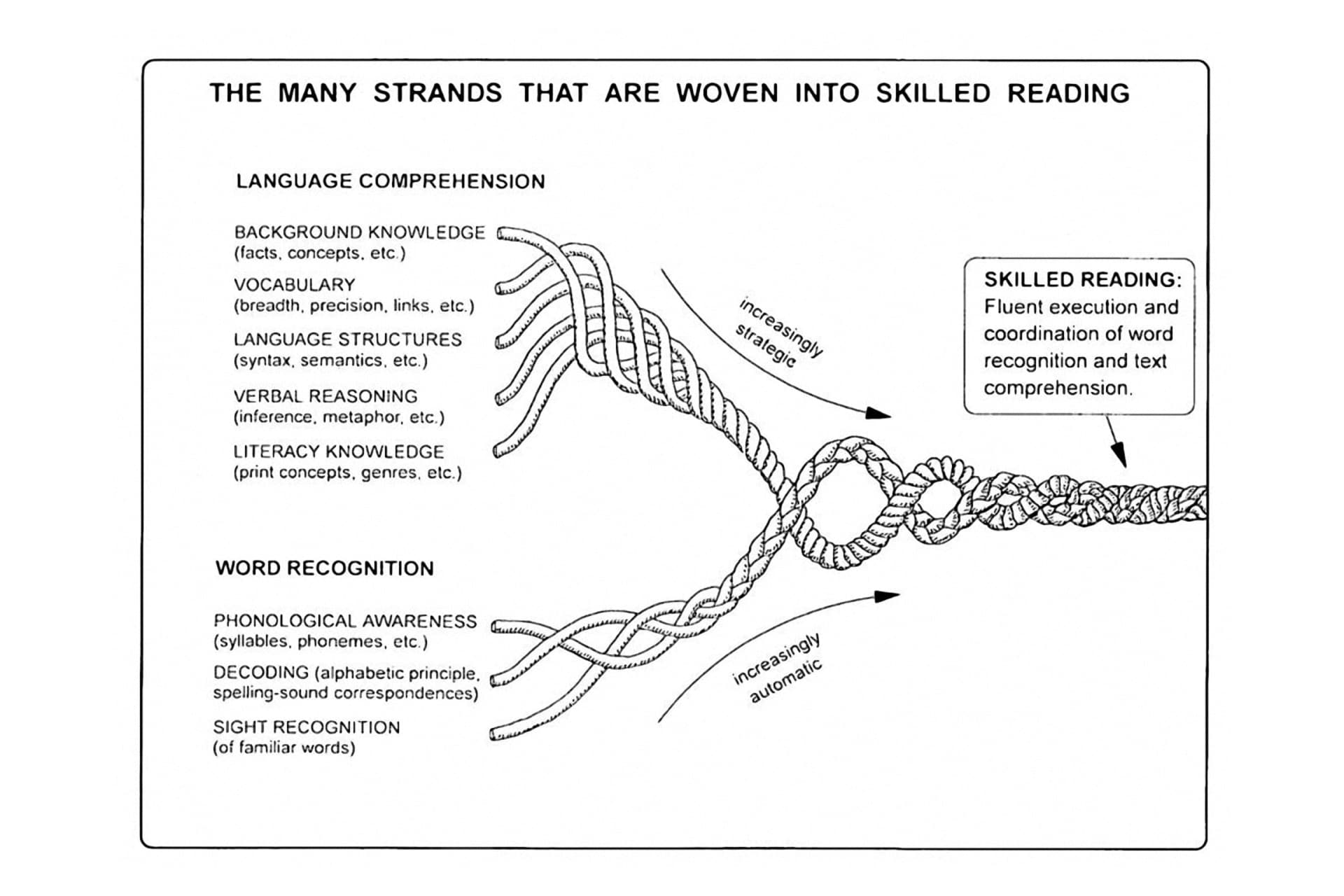
To further illustrate how the Science of Reading is incorporated into a reading program like Abeka, the consultants reference literacy expert Dr. Hollis Scarborough, who uses the threads of a rope to illustrate the development of skills over time that eventually lead to skilled reading. Scarborough shows how word recognition and language comprehension weave together to form skilled reading.
Scarborough’s Rope
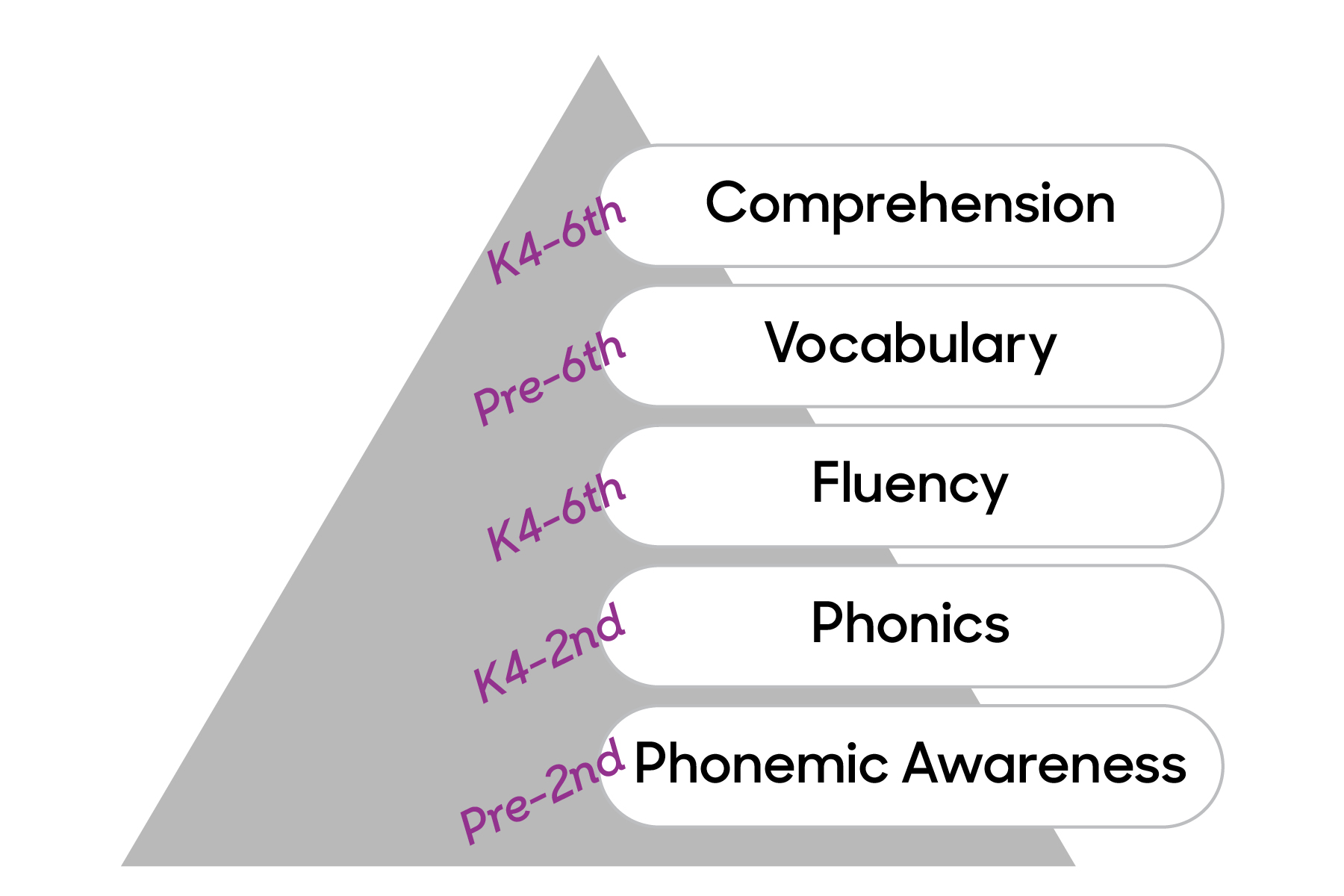
Abeka incorporates the following five pillars into learning at certain grades:
- Phonemic Awareness (Pre-2nd)
- Phonics (K4-2nd)
- Fluency (K4-6th)
- Vocabulary (Pre-6th)
- Comprehension (Pre-6th)
One of the misconceptions of reading programs (such as whole language) is that because they implement these 5 pillars, it means they are using the Science of Reading. However, in order for a reading program (such as Abeka) to be effective, it must . . .
- Have direct and explicit instruction.
- Be structured and sequential in a systematic approach.
- Have teachers who implement the pillars into the program.
If teachers do not actually implement the pillars into their classroom, students will not be able to read at a consistent rate. It may be about the what, but it’s also about the how.
The next video discusses the first two pillars: phonemic awareness and phonics.
Exploring the Science of Reading, pt. 2
After the foundation of the Science of Reading is laid, our consultants begin to define and discuss each pillar and its place in the Abeka curriculum.
Pillar One: Phonemic Awareness
The first pillar, phonemic awareness, is introduced during the preschool through second grade years. This pillar focuses on identifying sounds (hearing them), thinking about sounds (recognizing them), and manipulating sounds (making them). There are multiple places throughout curriculum that focus specifically on phonemic awareness:
- Teacher Curriculum: The teacher curriculum provides ways to introduce a specific letter and methods for describing what sound it makes, how to recognize it, and how to make the sound. It also implements different activities th at the teacher can introduce to help further solidify that particular sound.
- Worksheets: Worksheets allow students to practice the sounds that they just heard. They could either listen to the sound the teacher says and write that on their paper, or they could hear the sound and choose what letters represent that sound.
- Cultivation of Reading: Throughout the curriculum, there are different aspects that cultivate a desire for students to read. (For example, they recite poems about loving to read.) This focus should motivate them to learn more about reading and inspire them to learn correct pronunciation.
Phonemic awareness is a crucial skill in early reading development, allowing learners to recognize that words consist of distinct phonemes, or sounds. This awareness is essential for young readers’ proficient reading, as it underlies the ability to decode words and grasp their phonetic structure.
Pillar Two: Phonics
The second pillar of the Science of Reading is phonics, which is heavily emphasized from K4 through second grade. Phonics has the following six fundamental components:
- Short vowels
- Consonants
- Short vowel blends
- One-vowel rules
- Long vowels, long vowel blends, and two-vowel rule
- Special sounds and special sound blends
The purpose of these components in phonics instruction is to strategically build a young reader’s ability to read and spell words by understanding the relationship between sounds and their corresponding letters or groups of letters.
Orthographic Mapping
Another term that is essential to understand is orthographic mapping, the mental process used to permanently store words for immediate, effortless retrieval. Essentially, the more times that students see and read a word, the better their brains can later recognize the string of letters used to create that word. Orthographic mapping helps form the process that connects unfamiliar words to familiar words.
Some strategies for orthographic mapping include the following:
- Blending: Combining vowel and consonant sounds to form a new sound
- Special sounds: Combining letters in a certain way to form a new sound
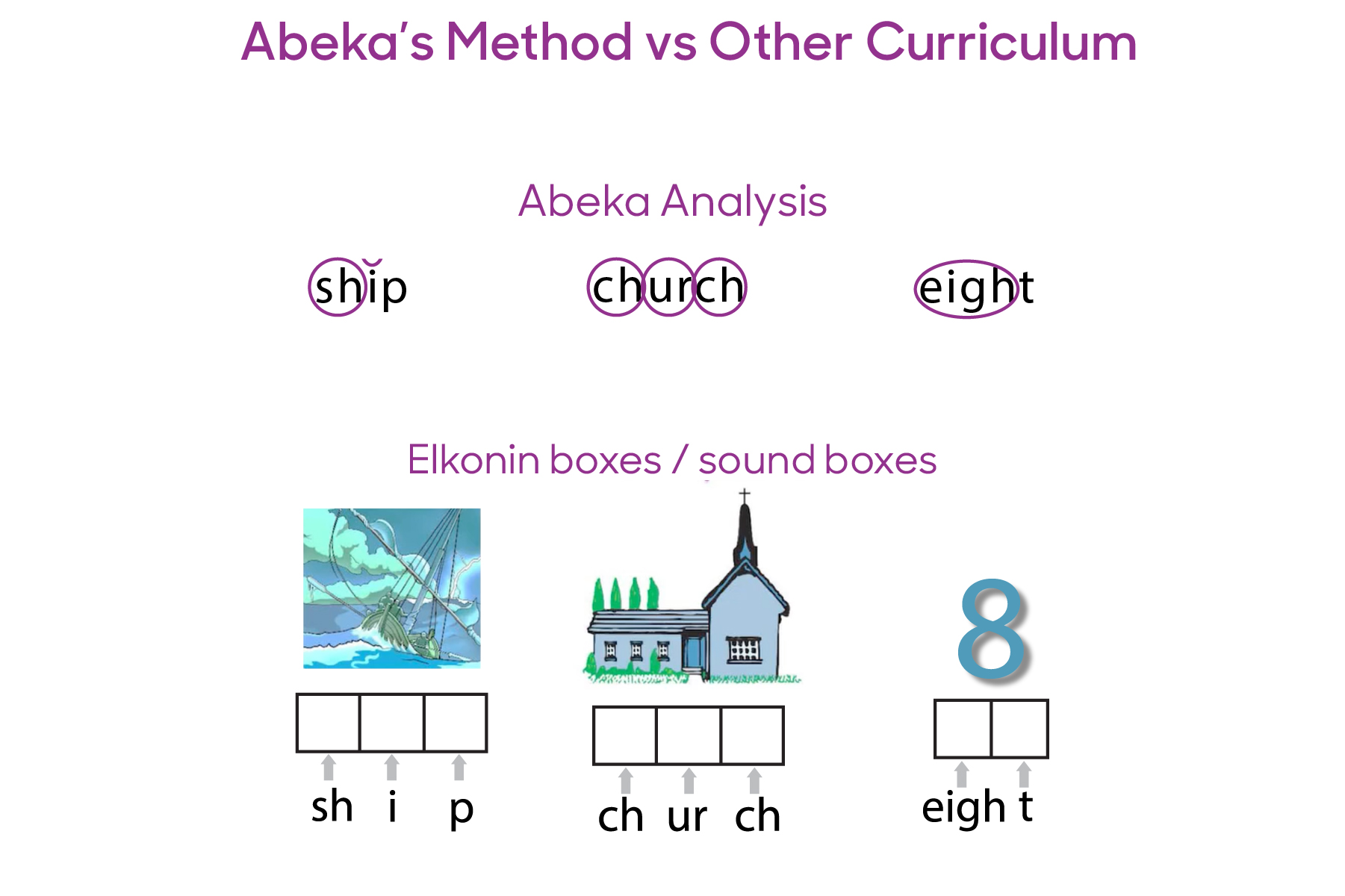
While some curricula use Elkonin boxes (sound boxes) to help students see the use of blends or special sounds in words, our consultants show an example of using a system that incorporates circling special sounds and using diacritical markings to identify vowel sounds. Abeka’s method is more portable and practical than boxes because it does not require the extra work of drawing boxes, and it does not confuse students with what they are trying to put in the box—they simply are looking for the blends and special sounds that they have already been taught.
Some other terms for teaching phonics are as follows:
- Letters: the components that make up a word
- Phonemes: the smallest unit of sounds in a word
- Graphemes: the way to write or spell a phoneme
Some ways that Abeka uses to help practice phonemes and graphemes are through worksheets, flashcards (include pictures and a sound), and clue word cards (include words associated with a phoneme) browse. These methods can be used in conjunction with different elements of the lesson such as the following:
- Warmups: use different exercises and games to help practice the phoneme
- Instruction: use different ways to identify the rule taught
- Spelling: use say-spell-say to help identify the sounds
Throughout warmups, instruction, and spelling, teachers should not just ask the student what sounds they hear but also ask how to mark it or even how to use it in a word.
Other terms that should be familiar in the Science of Reading are as follows:
- Diphthong: the sound made by two vowels in a single syllable (coin)
- Digraph: the sound made by combining two letters (phone)
- Consonant blend: the sound made by combining two consonants (glue)
- Morpheme: the word or part of a word that has a meaning (root word, prefix, suffix)
- Logograph: word shapes (look-say method) (This is a method to stay away from.)
Using Scarborough’s Rope as an illustration, phonemic awareness and phonics fall on the thread of word recognition, which is very valuable in learning how to read.
The next video discusses the third pillar: fluency.
Exploring the Science of Reading, pt. 3
Once the foundation of phonemic awareness and phonics is laid, teachers can then begin to help students be fluent in their reading abilities. Fluency is emphasized throughout all K4 and sixth grade. Fluency is the connection between recognizing words and comprehending their meaning, enabling readers to concentrate on understanding the text rather than on decoding individual words.
Pillar Three: Fluency
Fluency involves three key aspects:
- Read accurately: ability to read what is written without adding or omitting words
- Read automatically: ability to read without “thinking” about the phonics
- Read expressively: ability to read aloud with appropriate feeling
You’ve likely seen the Abeka curriculum use the term sight words; however, Abeka’s use of this term refers to words that don’t follow normal phonics rules. It does not refer to the whole language method.
While the focus of reading fluently is to help students read accurately, automatically, and expressively, Abeka incorporates character traits to instill in students the importance of thinking on things that are listed in Philippians 4:8: true, honest, just, pure, lovely, and of good report.
There are some oral reading qualities that the Abeka curriculum includes in teacher editions to help them know what to look for when students are reading in class:
- Accuracy
- Comprehension
- Expression (includes enunciation, smoothness, alertness to punctuation, volume, speed, and poise)
The teacher edition of the curriculum emphasizes one quality of fluency for teachers to focus on weekly to avoid focusing on every quality every time a student reads.
The more that students are exposed to words and reading, the more fluent they will become. Being fluent is not just guessing how a word sounds—it is the recognition and connection of particular sounds that make up words.
The fourth video discusses the last two pillars: vocabulary and comprehension.
Exploring the Science of Reading, pt. 4
As students become more fluent in reading, they can stop “thinking” about the sounds in each word and focus more on what the words mean and what the story is talking about. That’s where the last two pillars of the Science of Reading come in—vocabulary and comprehension. Both pillars are introduced in preschool but are more heavily emphasized as students get into upper elementary.
Pillar Four: Vocabulary
Vocabulary consists of understanding and using new words. Students are taught new words and practice using these words in different ways, such as filling in the blank, matching, and creating original sentences. The Abeka curriculum increases the number of spelling and vocabulary words as students move to higher grades. An example of this practice would be the increase from first through third grade:
- Grade 1: 420 spelling words
- Grade 2: 549 spelling words/54 vocabulary words
- Grade 3: 562 spelling words/119 vocabular words
Throughout the session, the consultants have mentioned two aspects of vocabulary that are useful to keep in mind:
- Domain Knowledge: Readers must know about 90–95% of the words in a passage to understand it. They can guess the other 5–10% from the context of the other known words.
- “Matthew” Effect: Domain knowledge applies to the parable of the talents found in Matthew 25. A man was given five talents, and another man was given one talent. The man who was given five talents added to his number five more talents. The man who was given one talent hid his in the dirt and did not add to his number. Essentially, the person who has a wide knowledge of vocabulary can gain an even broader vocabulary. Those who have a limited vocabulary will face limitations of what they can figure out on their own.
Pillar Five: Comprehension
The final pillar of the Science of Reading is comprehension, the ultimate goal of reading. To help with visualizing comprehension, use this formula:
- Vocabulary + Domain Knowledge = Comprehension
Domain knowledge is the ability to understand words that you read; however, it goes deeper than that, referring to the different domains (or areas) of life that you have, or don’t have, knowledge in. The more domains you are knowledgeable in, the broader your domain knowledge will be. Abeka uses various methods to help students increase their domain knowledge:
- Language Development: Uses a topic and builds students’ understanding of it. These are found in the teacher editions.
- Animal Alphabet Friends: Uses an animal that starts with a specific letter and gives interesting facts and details about that animal.
These are just a couple ways that Abeka incorporates domain knowledge into everyday teaching. With the vocabulary taught and the domain knowledge incorporated, the result is comprehension. Abeka includes comprehension questions at the end of stories for students to answer, helping them check their complete understanding of what they just read. (An example of this is found in Aesop’s Fables.) Another example that is used in the Reading Comprehension books is an activity in which students read a selection and mark details throughout the story that detail a particular action or emotion. This exercise checks their comprehension of the story on a different level.
Conclusion
The Abeka reading program applies the pillars of the Science of Reading in a simple, effective way. The Science of Reading is not one specific program, but rather a study that can be incorporated into programs such as the Abeka reading program. These five pillars—phonemic awareness, phonics, fluency, vocabulary, and comprehension—are essential to helping students become better readers.
We hope these sessions were valuable to you in understanding the Science of Reading! Let us know what you’d like to hear about next by commenting below or contact us at TeacherTalk@abeka.com.



Comments for The Science of Reading Explained—and How Abeka Aligns
Add A Comment
Your email address will not be published. Required fields are marked *